
01 Jul How Early Sitework Planning Protects Chicago Industrial Construction Schedules
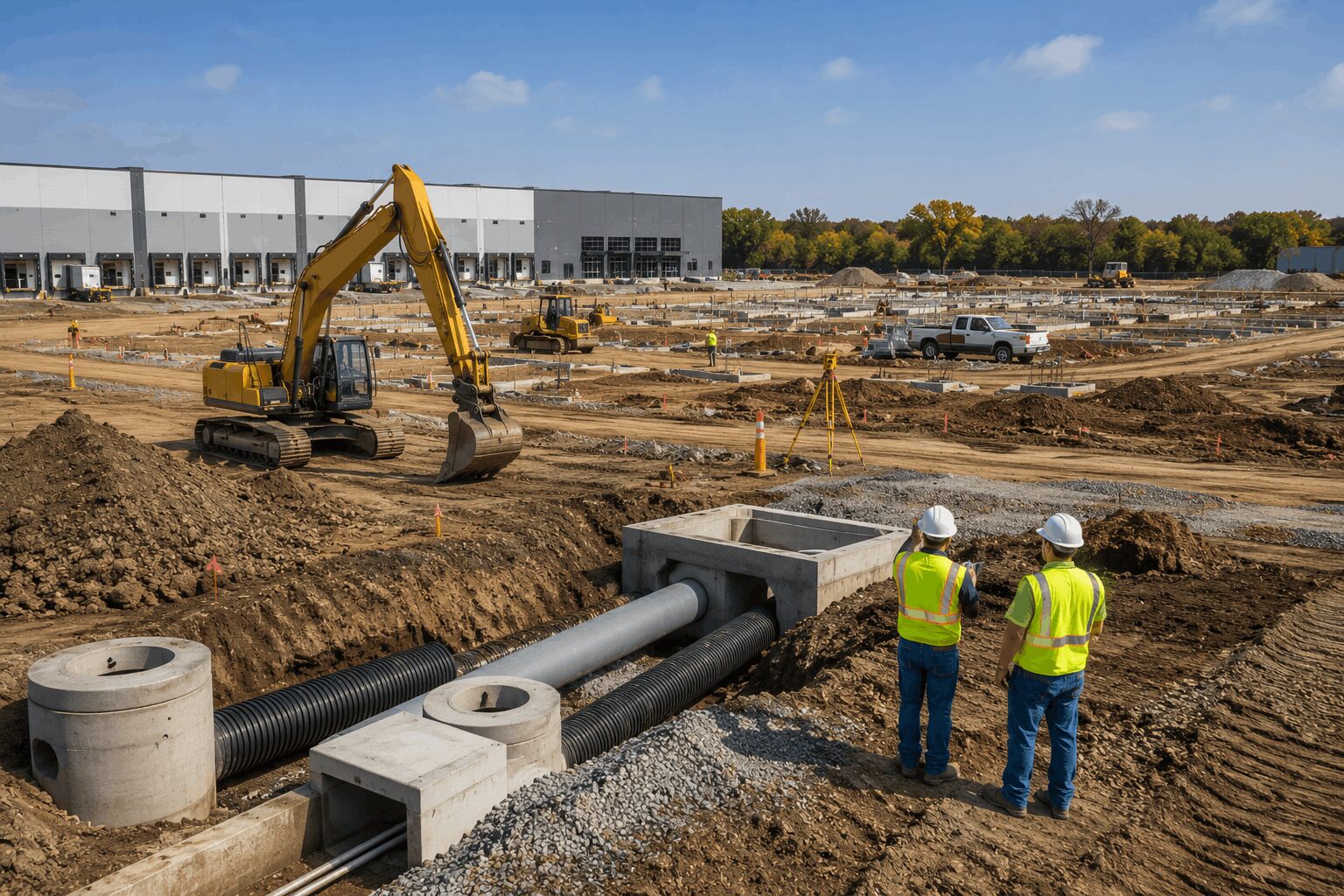
Summer provides an important window for this work. Longer days and generally favorable conditions can support excavation, grading, utility installation, concrete, and paving. At the same time, July schedules can become compressed quickly as developers try to complete enough exterior work before fall rain and winter temperatures begin affecting productivity. The best way to protect the schedule is to treat civil and sitework planning as a primary construction phase rather than a preliminary activity that will somehow resolve itself in the field.
Understand the Site Before Finalizing the Building Plan
Industrial site planning should begin with a clear understanding of what is above and below the property. Surveys, geotechnical reports, environmental information, utility records, drainage studies, and existing-condition documentation all contribute to that understanding. However, documents alone do not always tell the complete story. Previous property uses, undocumented fill, abandoned utilities, agricultural drainage systems, wells, septic components, buried foundations, and inconsistent soil conditions may affect construction once excavation begins. Early investigation helps the project team identify which risks can be confirmed before mobilization and which should be managed through allowances, contingency, sequencing, or additional testing. Soil conditions are among the most important variables. The building, slabs, pavement, and loading areas all depend on properly prepared subgrades. Weak, wet, compressible, or inconsistent soils may require removal, replacement, stabilization, surcharging, deep foundations, rigid inclusions, or other engineered solutions. These decisions affect more than cost. They influence how quickly the project can move from excavation to foundations and how the site can support heavy construction equipment throughout the build.
Meanwhile, earthwork calculations should be reviewed alongside the building layout and finished grades. A project that appears balanced conceptually may still require significant hauling when unsuitable material, topsoil, or moisture conditions are considered. Importing and exporting large amounts of soil affects trucking, neighboring roads, site access, dust control, and schedule. Identifying that movement early allows the contractor to plan haul routes, equipment, stockpiles, testing, and coordination with surrounding properties. Stormwater management is another major consideration. Large industrial roofs and paved yards create substantial runoff. Detention ponds, underground systems, swales, storm sewers, control structures, and erosion measures must be coordinated with the building, truck courts, roads, and future expansion areas.
Did you know that an existing farm drainage system can continue carrying water across an industrial development site even after the agricultural use ends? If field tile is not identified and redirected, it can introduce water into excavations, building pads, and pavement areas. That condition may not become obvious until grading disturbs the original drainage route. Utility planning should move forward at the same time. Water, sanitary sewer, fire service, electrical power, gas, communications, and process utilities may enter the site from different directions. Their routes must avoid conflicts with foundations, stormwater systems, roads, retaining walls, landscaping, and future additions. The team should confirm service capacity as well as location. A utility near the property does not automatically mean that it can support the proposed industrial use. Manufacturing, cold storage, automation, charging equipment, and high-density distribution can place significant demands on power, water, and fire protection. Provider applications, studies, agreements, easements, and equipment lead times should therefore be included in the master schedule.
Sequence Civil Work Around Construction Access and Midwest Weather
Once site conditions and utility requirements are understood, the contractor can create a sequence that supports the building rather than competing with it. The first objective is usually establishing safe, dependable access. Construction vehicles, concrete trucks, cranes, deliveries, and emergency responders need routes that remain usable through changing weather and active earthwork. Temporary roads and stabilized entrances may be necessary before permanent pavement is installed. Their locations should support the full construction sequence without interfering with utility trenches, foundations, building erection, or final site improvements. Building-pad preparation should be connected to foundation milestones. The pad must reach the required elevation, compaction, and moisture condition before excavation and concrete work proceed. Testing should occur as work advances so deficiencies are corrected promptly rather than discovered after the next activity begins. Underground utilities should be installed in a logical order. Deep systems usually come first, followed by shallower services. Crossings, sleeves, and building entries should be coordinated with structural and architectural drawings before crews reach those areas. A utility installed at the wrong elevation can affect drainage, foundations, equipment, and finished floors. Even a relatively small discrepancy may require rework when several systems converge near the building.
Meanwhile, the site must continue supporting construction. Open trenches, stockpiles, equipment, and temporary drainage can limit movement if work zones are not planned carefully. Weekly look-ahead coordination allows the superintendent, civil contractor, utility trades, and building team to adjust routes and priorities as conditions change. Summer weather is generally favorable for major sitework, but it is not completely predictable. Heavy rain can saturate soils, fill excavations, interrupt compaction, and damage temporary roads. High heat can affect workers, concrete placement, and equipment performance. The schedule should include realistic recovery procedures. Dewatering, soil drying, stone stabilization, pumping, temporary drainage, and material protection may be required after storms.
Paving decisions should also be made strategically. Installing final asphalt or concrete too early exposes it to heavy cranes, trailers, and construction traffic. Waiting too long, however, may push the work into colder conditions or leave the project without safe access for turnover. Many industrial projects benefit from phased paving. Base courses or temporary surfaces can support construction, while final lifts, striping, and detailed site improvements occur closer to completion. Truck courts, loading approaches, employee parking, fire lanes, and trailer areas should each be designed for their expected loads and use. Pavement sections that are appropriate for passenger vehicles may not withstand repeated trailer movement or concentrated loading near docks. Exterior closeout should include drainage testing, pavement review, striping, signage, lighting, curbs, sidewalks, landscaping, and restoration of areas affected by temporary construction. These items often occur while interior startup and commissioning are also underway, so coordination remains important through the final phase. Early sitework planning gives owners and developers more than a cleaner schedule. It creates better cost visibility, reduces conflict between civil and building activities, and gives the construction team a more dependable platform for everything that follows.
Keeley Construction combines predevelopment, preconstruction, civil coordination, full construction services, and industrial building expertise across Chicagoland and the Midwest. From large-scale grading and infrastructure through building completion, Keeley helps owners connect site conditions with the operational goals of the finished facility.
Planning a warehouse, distribution center, manufacturing facility, or industrial campus in the Chicago area? Contact Keeley Construction to begin evaluating the site, infrastructure, and most effective path to construction.