
01 May What Developers Should Know Before Building a BESS Site
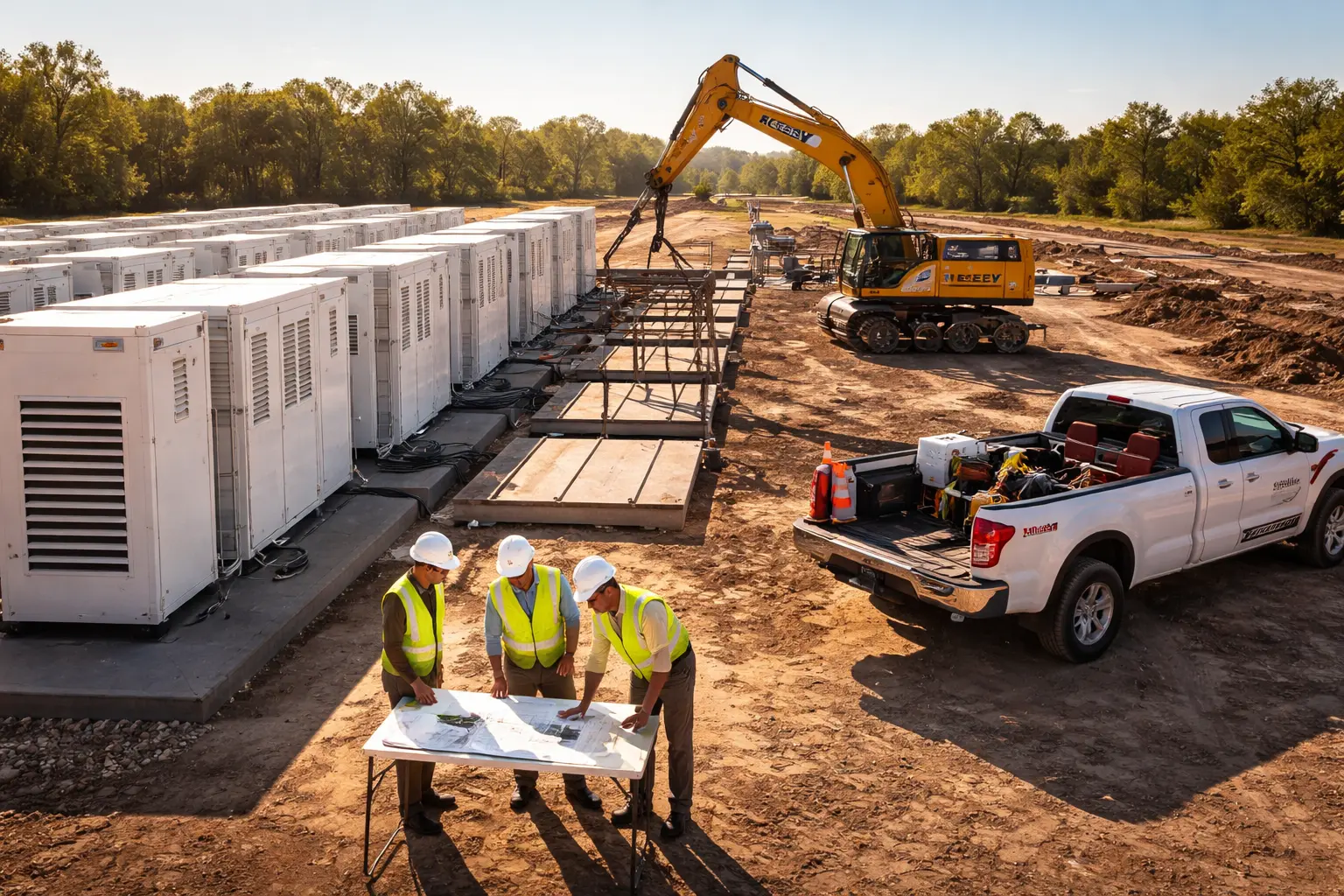
Battery energy storage projects move fast on paper. In the field, they demand much tighter coordination than many teams expect. A BESS site is not just a collection of pads and equipment set on an open parcel. It is a dense, high-tolerance project where grading, access, foundations, utility planning, and equipment sequencing all have to come together without much room for error.This is especially relevant in Q2, when many energy teams are pushing preconstruction decisions toward site mobilization. Once that transition happens, problems become much harder to solve cheaply. That is why the smartest BESS projects are usually the ones that slow down just enough in preconstruction to avoid losing time later.
Site Readiness Is More Than Clearing and Grading
One of the easiest ways to underestimate a BESS project is to think of site prep as a routine early package. We have seen sites look ready from a distance and still create trouble once installation starts. Minor elevation issues, access limitations, drainage conflicts, or poorly coordinated trenching can ripple through the entire layout.
What matters here is precision. Equipment density is high. Tolerances matter. And once multiple scopes are moving at once, small misalignments stop being small. That is why early civil coordination matters so much on these sites.
Equipment Sequencing Has to Match the Site Reality
BESS work often involves containers, inverters, transformers, trenching, pads, and interconnections that all depend on one another. If the sequence breaks down, crews start waiting on each other, rework enters the picture, and schedule confidence drops fast. We have seen teams lose momentum not because the project was impossible, but because deliveries, foundations, and utility work were not aligned with how the site was actually going to be built. Bigger is not always harder. Sometimes the tighter, more compact projects demand more discipline because everything is happening in closer quarters.
Safety and Access Need to Be Designed Into the Build
A BESS site does not perform well when safety planning is treated as a separate conversation from construction planning. Access routes, equipment clearances, laydown areas, and installation sequencing all affect how safely the site can be built and maintained.
This becomes even more important when multiple trades are active at once. A clean site plan on day one is not enough. The build has to stay workable as the site gets more crowded and more complex.
Long-Term Performance Starts During Construction
Developers are often focused on energization milestones, and understandably so. But long-term site performance starts much earlier than that. Drainage, foundation quality, trench layout, and access decisions all affect future maintenance, reliability, and serviceability.
The projects that hold up best are usually the ones where construction decisions were made with operations in mind. That is not extra planning. It is the planning that keeps the site from becoming harder to own once it is live.
BESS construction rewards teams that bring discipline to the early phases. The projects that feel smooth in the field usually got there because somebody asked the hard coordination questions before mobilization started. For developers, that means looking beyond equipment procurement and treating site readiness, access, sequencing, and constructability as core drivers of project success. On a BESS site, those details shape everything that follows.